Thursday, February 22, 2007

The Further Adventures of a Conrad Veidt Devotee: Contraband

Contraband (1940) was the first movie Michael Powell and Emeric Pressburger fully collaborated on after making The Spy in Black the year before. A comic thriller set in a London blackout, Conrad Veidt plays Captain Andersen, a stern, imposing man who has a taste for adventure and a liking for smart, “troublesome” women. Captain Andersen commands the Helvig, a Danish freighter that's been delayed in port by British customs agents on the lookout for military contraband. While the ship is docked, two passengers slip ashore, though they've been ordered to stay aboard, Mrs. Sorensen (Valerie Hobson) and Mr. Pidgeon (Esmond Knight). The Captain has already had trouble from Mrs. Sorenson, a willful Englishwoman who believes that rules are made for other people, and his blood is up. Affronted by his passengers’ disobedience and, by law, responsible for his passengers while in port, Captain Andersen goes ashore to find them. After catching up with Mrs. Sorenson in London, circumstances reveal that she’s a British spy who, with Andersen, falls into the hands of a Nazi cell operating out of the basement of a Soho nightclub.

While the plot is reminiscent of early Hitchcock, the style and tone of the film is pure Powell. Rather than take itself seriously, Contraband’s thriller plot is constantly lightened up by tongue-in-cheek humor and romantic badinage (as well as a fair amount of what Ken Russell has called "bondage overtones"). Though it's not as developed visually as some of his later films, you can see the beginnings of certain stylistic tendencies in the film. Contraband contains several shots and sequences that appear in his later films, such as the eerie, fog enveloped men working on ships in the harbor, for instance, and the combination of a rapid close up of a clock face and the blaring of a train whistle from I Know Where I'm Going!.

Contraband seems to be overlooked by most viewers, even fans of Powell and Pressburger, as a pale imitation of a 1930s era Hitchcock thriller, but though it may be one of their lesser films, I thoroughly enjoyed its humor and felt it had all of the elements, whether fully developed or not, that one expects of an Archers film.

Senses of Cinema Review by Alexander C. Ives


Saturday, February 17, 2007

Get Your Art House On: Fifty Years of Janus Films at LACMA

From March 2 to April 7 LACMA will be showing new 35 mm prints of 23 of Janus Films' essential art house collection. All your favorites from film studies are here: Rashomon, The 400 Blows, The Seventh Seal, L'Avventura, and Knife in the Water as well as some films you may have missed. The selection focuses mainly on films from the 1950s and 60s, but also includes films from beyond, such as The Rules of the Game and, oddly, Pygmalion. Double Features on Friday and Saturday evenings start at 7:30 pm at LACMA's Leo S. Bing Theatre.

Tickets & Information
$9; $6 for museum and AFI members, seniors (62+), and students with valid ID. Price includes both films in a double bill, except where noted. $5 for the second film only with no advance purchase.

Please note: many programs sell out. Tickets are on sale now and may be purchased at the museum box office. For information call the box office at (323) 857-6010. Purchase of a film ticket includes entrance to the galleries.

Saturday, February 03, 2007

Conrad Veidt in The Indian Tomb

In answer to your question...No, I haven't tired of Conrad Veidt yet. I'm still enthralled. My most recent experience was the 1921 epic The Indian Tomb written by Fritz Lang, but directed by Joe May. Conrad Veidt stars as the vengeful but brooding Ayan III, the Maharajah of Bengal, who has a diabolical plot against his unfaithful wife (Erna Morena) and her British lover (Paul Richter). Ayan vows to build a tomb to his dead love and hires English architect Herbert Rowland (Olaf Fonss) to build it for him. Sworn to secrecy Rowland leaves abruptly, but his fiancee Irene (Mia May) follows him to India where danger and adventure begin.

At 3 1/2 hours long, I was somewhat hesitant to start watching this film, but it's like a good, old fashioned serial full of chases, danger, and women in distress and since it's set in India tigers, pythons, and yogis. And the key here is to treat it like a serial and watch it over a period of days. There is simply no way to watch it all at one sitting, you'll go mad. That being said, once you get used to the tempo and style of the film it really draws you in. One of the most expensive films of the 1920s, The Indian Tomb has impressive special effects and elaborate and beautiful sets that seem to go on forever.

The best thing about The Indian Tomb, however, is Conrad Veidt. Easily the best actor in the film, his portrayal of Ayan is fascinating and complex. Though clearly the "villain," Veidt imbues his character with pathos, eliciting our sympathy and our interest. Veidt's performance is highly stylized, using slow, almost dance-like movements, making him mysterious and otherworldly in comparison to those around him. With his piercing eyes, almost skeletal frame, jewels, velvet and satin clothes, Veidt portrays Ayan as the western image of a feminized oriental, emotional and irrational, and subject to cruel whims and desires. Though Ayan is never "manly" in the western sense, the scene where he suddenly appears masquerading as an androgynous temple deity emphasizes this representation.

Some reading to complicate your fun:
Orientalism by Edward Said
The Location of Culture by Homi Bhabha

Wednesday, January 31, 2007

Love Gone Wrong for Valentine's Day

I love a theme and apparently the folks at Kino Video do, too. In order to celebrate the "romance and heartbreak" of Valentine's Day they're taking 30% off their series of "Love Gone Wrong" films. Included are the G. W. Pabst/Louise Brooks classic Diary of a Lost Girl, Fritz Lang's 1945 noir Scarlet Street, and the 1924 Carl Dreyer silent Michael, as well as more contemporary films, such as Wong Kar-Wai's Happy Together, Rajiv Menon's I Have Found It, and Claude Chabrol's Betty. So if Valentine's Day soppiness leaves you feeling bitter and mildly ill, at least you know that the understanding film hounds at Kino Video are thinking of you.


Sunday, January 21, 2007

All Through the Night

All Through the Night (1941) is a delightful romp through wartime propaganda. A comedy thriller with Bogart as a wisecracking New York gambler who stumbles onto a group of Nazi fifth colmunists who are planning to sabotage a battleship anchored in the harbor. Bogart rallies his small group of lovable underworld gangsters in a sudden burst of patriotism to overthrow a rather large group of Nazi operatives. All Through the Night is a rather generic wartime film that relies almost completely on its major characters playing parts they'd played in many films before. Conrad Veidt is the suave, almost friendly, but dangerous Nazi leader, Bogart plays his usual fast talking tough guy slightly more tongue in cheek than usual, and Lorre is a somewhat scummy lower echelon bad guy in the vein of Joe Cairo or Senor Ugarte. Likewise, Judith Anderson, Jane Darwell, Frank McHugh, and William Demerest all play parts we've all seen them play in better films. As a result, All Through the Night is a very comfortable, familiar experience, along the lines of the Bob Hope/Bing Crosby movies they used to show on Tom Hatten's Family Film Festival when I was a kid. There are several good lines in the film, mostly spoken by Bogart and his cronies, which taken with the performances themselves make the film worthwhile.

Saturday, January 20, 2007

My obsession with Conrad Veidt continues

In an attempt to deny the fact that school has started again I have provided myself with a pointless obsession, the films of Conrad Veidt. Between those crazy kids at netflix and the used VHS tapes to be found on amazon, I am racking up quite a number of wasted hours watching movies no one even seems to know exist. So far, since The Man Who Laughs, I have seen Different From the Others (Germany, 1919) and All Through the Night (US, 1941). There's a contrast for you! Different From the Others is about a gay concert violinist Paul Korner (Conrad Veidt) who falls in love with one of his students and is blackmailed by a predatory criminal (Reinhold Schunzel) who threatens to expose him to the police. (Under Paragraph 175, Germany's anti-gay legislation, homosexuals could by imprisoned for up to five years) A sort of sex hygiene film, the well meant but didactic lecturing of "Dr. Magnus Hirschfield of the Institute for Sexual Science" tends to interfere with the storyline, being, as it is, only halfheartedly integrated into the plot. It's an interesting film, however, primarily because it reflects that brief moment of openness in Weimar Germany before Hitler came to power. The acting tends to be rather melodramatic by today's standards (Veidt spends rather a lot of time looking woebegone and lost with a hand to his head) and the makeup is a scream (I think we are supposed to intuit from the dark circles around his eyes that Reinhold Schunzel is the bad guy) but there are aspects of the film which make it worth seeing. Censored by the German government and later burned by the Nazis as "degenerate," a print of the film was found in the Ukraine and restored by the Filmmuseum Munchen. Missing sections of the film have been replaced with explanatory intertitles and still photos.

Tomorrow: All Through the Night

Sunday, January 14, 2007

Conrad Veidt: The Man Who Laughs

If you’re like me, you’ve only seen Conrad Veidt in a couple of films: as the sleepwalker in The Cabinet of Dr. Caligari (1920), as the mean, nasty Major Strasser in Casablanca (1942), and the equally evil Jaffar in The Thief of Bagdad (1940). Until now, I had never seen any of the films he’d made in the twenty years between making a groundbreaking German Expressionist silent and playing smug bad guys in British and Hollywood movies. I had some recollection that he’d made some spy flicks for Michael Powell at some point, but I’d never seen them. So while looking for silent horror movies to watch on Netflix, I found the 1928 American silent horror classic The Man Who Laughs.

An adaptation of a Victor Hugo novel, Veidt plays the role of Gwynplaine, a nobleman's son, who is kidnapped by a political enemy and mutilated by a gypsy "surgeon" who carves his mouth into a hideous grin. Left behind by the gypsies as the flee the country, Gwynplaine wanders through a landscape of hangman’s gallows and snowy cliffs surrounding by poor people freezing to death in the snow. After rescuing a baby from her dead mother’s arms, he finds shelter with an old man who takes pity on him and his charge. Years later, Gwynplaine and his “family” have become a traveling circus act, in which he plays a clown, laughed at and taunted by the audience. He and the blind girl (Mary Philbin The Phantom of the Opera) fall in love, but they almost lose each other when Gwynplaine is drawn back into the world of political intrigue. He becomes the plaything of a jaded duchess (Olga Baclanova Freaks), and his enemies renew their efforts to control him.

If silent movies are too remote and melodramatic for you, this film may change your mind. Like many films of the time, it does seem to move rather slowly since we are used to a faster pace and more action, but The Man Who Laughs is visually quite beautiful in the way that German Expressionist films always are and Veidt’s portrayal of Gwynplaine is impressive. Considering that the only tools a silent actor really had were his facial expressions and his body language, Veidt managed to convey a great emotional expressiveness through only his eyes and hands, much of his face maintaining a continuous smile throughout the film. (From the photo, you can see how Veidt’s Gwynplaine must have been the origin for the Batman character The Joker).

Created in the same vein as other Universal successes like The Hunchback of Notre Dame and The Phantom of the Opera (adaptations of other French novels in which a disfigured man looks for love from a sympathetic woman), Carl Laemmle hired two influential artists of the German Expressionist School: actor Conrad Veidt and director Paul Leni (Waxworks). German Expressionist aesthetics, as seen in The Man Who Laughs, laid the foundation for several popular American film genres such as noir and Universal horror films like Dracula, Frankenstein, and The Wolf Man.

The Kino DVD has several extras, but for me the most intriguing was a German short entitled “Filmstadt Hollywood” which contains home movies of Conrad Veidt relaxing with fellow European emigres Greta Garbo, Emil Jannings, Paul Leni, Carl Laemmle, and Camilla Horn.

The German Hollywood Connection

Tuesday, September 26, 2006

THIS JUST OUT Ballet Russes


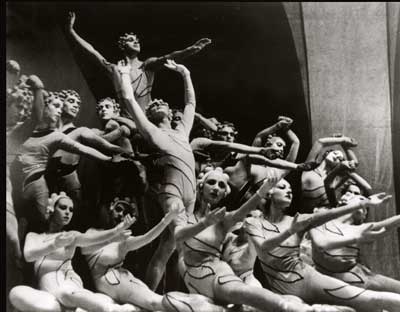
Dayna Goldfine and David Geller’s 2005 documentary about Colonel de Basil’s Ballet Russes de Monte Carlo and the subsequent “ballet wars” is out on DVD. Good news for all of you who (like me) weren’t able to go see it when it played last year for fleeting moments in far flung and obscure theatres across the country. (Honestly, it wasn’t that far away, but cross basin traffic made it seem so).

After briefly acquainting the viewer with the history of Diaghilev’s Ballets Russes, Goldfine and Geller detail how the Ballets Russes de Monte Carlo was created as a continuation of the Diaghilev ballet and endured in various forms for over 30 years. The ballet companies encouraged some of the most unique artistic collaborations in the twentieth century and brought ballet to countries that had no previous exposure to it. Without Diaghilev’s Ballets Russes and the two companies that followed, there would be no ballet tradition in the U.S. nor would the talents of such genius as George Balanchine be known today. Through interviews with surviving members of the ballets and archival photos and film footage, the film captures a fascinating time in the history of dance. I’m sure Ballet Russes would have been even more enjoyable on the big screen, but you take what you can get.

Ballet Russes Site
Diaghilev Ballets Russes Season by Season
Frederic Franklin: 30 Years of Ballets Russes de Monte Carlo
A Ballet History
Danilova Collection at the Library of Congress

Books of Interest:
Irina: Ballet, Life and Love by Irina Baronova
The Ballets Russes: Colonel de Basil's Ballets Russes de Monte Carlo 1932-1952
Leonide Massine and the Twentieth Century Ballet
Massine: A Biography
Maria Tallchief: America's Prima Ballerina

On DVD:
Ballets Russes
Balanchine
Picasso and Dance
Gaite Parisienne

Thursday, September 21, 2006

TO DO IN LOS ANGELES “Where were you in ’82?” American Hardcore at the ArcLight

Feeling nostalgic? Longing to go back and revisit your punk rock past? Well, pull the docs out of the closet and head on over to the Arc Light because American Hardcore is showing tonight at 8pm. Directed by Paul Rachman from a screenplay by Stephen Blush (from his book of the same name) American Hardcore covers the history of the first generation (or only generation, depending on your viewpoint) of American punk, from 1980 to 1986, and charts the rise of bands like Black Flag and The Misfits. The film uses archival footage interspersed with interviews with members of 7 Seconds, The Adolescents, Black Flag, The Circle Jerks, and DOA. Rachman and Blush explore how Reagan-era conservativism created a tribe of disaffected youth who saw no hope in government institutions, leftist politics, or any global ideologies.

I feel compelled to warn you, however, this film does contain interviews with Henry Rollins, self-appointed expert-on-all-things-punk, and prolonged exposure to Rollins Pontification can be hazardous to your health. I know it is to mine.

Q&A after screening with filmmakers Paul Rachman and Steven Blush, Keith Morris of The Circle Jerks, and Jack Grisham of TSOL.

ArcLight Hollywood is located at 6360 W. Sunset Boulevard in Hollywood
THURSDAY, SEPTEMBER 21, 8:00 PM
Tickets are $11, $10 for ArcLight, AFI and Skirball members, on-site parking is $2 for four hours with validation. To order advance tickets, go to www.arclightcinemas.com, call 323.464.4226 or visit ArcLight Hollywood's box office at 6360 W Sunset Blvd. (at Ivar). Admission prices may vary depending on event.

View Trailer

Tuesday, September 19, 2006

TO DO IN LOS ANGELES Strange Dreams of Present and Future

On Saturday, September 23 at 7:30pm, American Cinematheque at the Egyptian Theatre will be showing a group of film shorts that deal with life in the near future. While I have not seen the majority of the films, I am pleased to see that James Oxford’s “Smartcard” (US, 16 min) is among them. I had the privilege to see this film last January at Smogdance Film Festival where I was “working” as one of the festival’s judges and consider it one of the best films screened there.

Smartcard is about a world in which every aspect of life is integrated by the smartcard, a sort of credit card, keycard, and personal information record in one. Not only do you use your smartcard to get into your car and have it drive you, but to purchase goods, record your medical history, and every other sort of personal information. Your card knows the quickest way to drive you home, what food is lacking in your refrigerator, and what is best for you. In short, smartcard manages you, helping you to make decisions that enrich your life and make you a better consumer, I mean person. Tired from work and want to put off going to the market? Smartcard has decided that it would be better for you to do it now. Craving a candy bar at the minimart, smartcard knows that your doctor has determined that junk food is bad for you. While the smartcard starts by being annoyingly “helpful” and manipulative, by the end "Smartcard" suggests that there are more troubling reasons to be wary of integrated computer information systems.

Other films being shown are Jonathan Joffe’s "Cost of Living" (Canada, 10 min), which examines how much a man is willing to pay for possible immortality. Christopher Leone’s "K-7" (US, 18 min), in which an ordinary job interview becomes a battle for life or death when Vincent Kincaid rates a high score on his psychological profile. Jeremy Haccoun’s "Paradox" (UK, 19 min). Are the two gentlemen in a well? Are they in the present or in medieval times? Michael Lucas’ "Turn" (Australia, 11 min) a surreal comedy about love, traffic and survival.

Films will be screened in the Spielberg Theatre (the smaller one in the Egyptian, not the Lloyd E. Rigler Theatre) at the Egyptian with a discussion with directors Christopher Leone (K-7) and James Oxford (Smartcard) to follow.

Grauman’s Hollywood Egyptian Theatre is located at 6712 Hollywood Boulevard between Las Palmas and McCadden, just east of Highland Avenue in Hollywood.
Tickets are General Admission $9.00 (unless otherwise noted), Cinematheque Members $6.00, Seniors 65+/Students w/valid ID $7. 24-HOUR PROGRAM INFO: 323.466.3456

American Cinematheque
Program Information

Sunday, September 17, 2006

Celebrate the Swedish Sphinx’s Birthday on September 18


"I never said, 'I want to be alone.' I only said, 'I want to be left alone.' There is a whole world of difference."

With her breathtaking beauty and enigmatic persona, Greta Garbo remains the ultimate Hollywood icon. As MGM’s highest-paid star, Garbo had approval of story, costar, director and cinematographer, often closing the set to visitors and crewmembers. For fifteen years, Garbo wielded power that few could match—yet she was often at odds with the system that made her a phenomenon. She was famous for her reclusive lifestyle, which became part of the Garbo mystique. Except at the very beginning of her career, she granted no interviews, signed no autographs, attended no premieres, and answered no fan mail.

While Greta Garbo made over 25 films in Hollywood, many of them are unfamiliar to contemporary audiences due to a prejudice against silent films. But these are the films that made her famous and established her legendary association with John Gilbert.

THE TORRENT (1926) Garbo’s first film in the U.S. Directed by Monta Bell, Garbo plays Leonara, a Spanish peasant girl who is sent to Paris and becomes an opera singer.

FLESH AND THE DEVIL (1926) Directed by Clarence Brown and costarring John Gilbert. This marked Garbo’s first collaboration with director Clarence Brown as well as her first film with John Gilbert. This story of fallen love broke box office records across the country and established Garbo and Gilbert as great lovers of the silver screen.

LOVE (1927) Directed by Edmund Goldberg. The tagline for this film read simply, “Garbo and Gilbert in Love.” Garbo’s first version of Tolstoy’s Anna Karenina, made with two endings, happy and sad.

THE KISS (1929) Directed by Jacques Feyder. This was the last film MGM made without dialogue (it used a soundtrack with music and sound-effects only), and marked the end of an era. A courtroom drama in which Garbo is tried for the murder of her jealous husband.

If you can’t sit through silent films, Garbo successfully transitioned into talkies to make the following films:

ANNA CHRISTIE (1930) Directed by Clarence Brown. Garbo Talks! Garbo’s low, husky voice was heard on screen for the first time in Eugene O'Neill's Anna Christie. The movie was a huge success, but Garbo personally hated her performance. Audiences waited 16 minutes for her entrance to hear her say, “Gimme a whiskey, ginger ale on the side. And don’t be stingy, baby.”

ROMANCE (1930) Directed by Clarence Brown. Garbo plays prima donna Rita Cavallini in this period drama. She was nominated for the Academy Award for Best Actress for this film as well as Anna Christie, but lost to Norma Shearer in The Divorcee.

QUEEN CHRISTINA (1934) Directed by Rouben Mamoulian. A historical drama that takes considerable liberty with fact. Christina inherits the Swedish throne in 1632 at the age of 6 after her father’s death on the battlefield. When she refuses to marry and produce an heir, she is forced to abdicate at the age of 28. This film tones down Christina’s lesbianism, but portrays her as a progressive woman of intelligence and sophistication who could not bow to the limitations placed on women of her time. One of my favorites.

CAMILLE (1936) Directed by George Cukor. Her performance as the doomed courtesan in Camille was called the finest ever recorded on film. Garbo was nominated for Academy Award for Best Actress again.

NINOTCHKA (1939) Directed by Ernst Lubitsch. Garbo in her first comedic role, Ninotchka was one of her favorite films and for which she was nominated for the Academy Award for Best Actress again. Garbo plays a Soviet agent in Paris who falls in love with a French nobleman. Another favorite.

"Her instinct, her mastery over the machine, was pure witchcraft. I cannot analyze this woman's acting. I only know that no one else so effectively worked in front of a camera." —Bette Davis

Saturday, September 02, 2006

TO DO IN LOS ANGELES AFI at ArcLight Presents Auntie Mame


"Life is a banquet and most poor suckers are starving to death."

On Wednesday, September 6 at 8 pm AFI at the ArcLight will be showing the classic Hollywood comedy Auntie Mame. Starring Rosalind Russell, Forrest Tucker, Coral Browne, Fred Clark, and Roger Smith, Auntie Mame (Rosalind Russell) is a free-spirited socialite from the Roaring ‘20s forced to settle down and raise her nephew Patrick (Roger Smith) when her conservative brother dies. Mame immediately sets forth to expose her sheltered charge to all the wonders of New York, but a stuffy executor appointed by Patrick's father tries to protect the boy from experiencing too much of Mame's unconventional lifestyle. Despite his father’s preparations, Patrick and Mame quickly become devoted to each other and journey through the Great Depression collecting madcap adventures.

Tickets are $11, $10 for ArcLight, AFI and Skirball members, on-site parking is $2 for four hours with validation. To order advance tickets, go to www.arclightcinemas.com, call 323.464.4226, or visit ArcLight Hollywood's box office at 6360 W Sunset Blvd (at Ivar). Admission prices may vary depending on event.

Experience the irrepressible Mame in the original Patrick Dennis novels: Auntie Mame: An Irreverent Escapade and Around the World with Auntie Mame

Uncle Mame: The Life of Patrick Dennis
But Darling, I'm Your Auntie Mame!

Friday, September 01, 2006

FILM REVIEW Hour of the Furnaces Part 1

El Grupo Cine Liberacion’s 1968 film, The Hour of the Furnaces, directed by Fernando Solanas, is an overview of how colonialism and neo-colonialism have disenfranchised the Latin American people from the Spanish conquest to the contemporary period as seen from a radical left perspective. Broken into sections in which it discusses different effects of colonialism and neo-colonialism, the final section provides a solution for the entire range of issues at work in Argentina: the transfer of power from the ruling class to the people through armed revolution.

Subtitled "Notes on Neo-Colonialism, Violence and Liberation," The Hour of the Furnaces juxtaposes quotes by writers and political figures such as Jean Paul Sartre, Aime Cesaire, Juan Peron, Fidel Castro, Che Guevara, Simon Bolivar, Frantz Fanon, and others, with documentary footage, archival stills, and voiceover narration in a Soviet montage-style agitprop piece. The Hour of the Furnaces focuses its attention largely on the various forces that work to impoverish and oppress the Argentinean people and sites the agrarian oligarchy, the industrial bourgeoisie, the military, and a corrupt government as the contemporary forces of neo-colonialism that maintain power over the wealth of the entire nation in the form of land, industry, and labor. While the oligarchy owns the overwhelming majority of farmland in the country, the bourgeoisie control trade and industry centered in Buenos Aires. The interests of both are served by the government and its military that legalize their policies and financial interests at the expense of the workers.

In addition to the economic system of oppression is the ideological oppression created by the triumvirate of church, mass media, and the importation of imperialist cultural products. The film makes a comparison between the church and faith healers, mind readers, and charlatans to show how the church benefits the ruling class by “sowing confusion” and replacing indigenous cultural practices with western culture through missionaries working in rural communities.
Likewise, the mass media serves to distract the people from a true understanding of their powerlessness in society by disseminating the ideology of the ruling class while suppressing discontent and dissent among the people. In the most arresting section of the film, graphic shots of cows being led through a slaughterhouse are interspersed with shots of advertising stills and young people dancing and buying records. American popular music is played continuously in this scene while the narrator echoes the ideas of Theodor Adorno, namely, that all mass media serves to keep the masses obedient to market forces as well as distracting the people from their oppression and exploitation. While the people think they are making their own decisions about what to buy and what cultural products to enjoy, they, like the cows in the slaughterhouse, are being led by a manipulating force to act against their own interests in favor of those of the ruling class. The film’s attitude toward this behavior is not entirely sympathetic, however. It suggests that by accepting the products of the mass media, Argentinean people have become complicit in the system of economic and cultural imperialism.

All of these sections taken together lead the filmmakers to their concluding section, The Choice. In this section, the filmmakers proclaim that the only way to correct the false history of colonialism and neo-colonialism is to “replace imperial violence with revolutionary violence” and suggests that martyrdom to the revolution will free not only future generations, but the one martyred as well. After the voiceover narration ends, a still of their ideal revolutionary martyr, Che Guevara, is shown in death.

While the statistics and much of the other specific information provided in this film now function only historically, aspects of The Hour of the Furnaces are perhaps more accurate today that they were in 1968, especially in its exploration of the effects of American cultural hegemony and its economic dependence upon cheap foreign labor. In addition, its indictment of the United States’ policy of supporting repressive governments through material and economic means shows the filmmakers’ tremendous foresight considering the events that would take place in Central America and elsewhere over the next twenty years. The film’s main importance lies, however, in its detailed explication of the causes and effects of neo-colonialism in Argentina and in the dramatic ways in which Solanas delivers its meaning.

Though this film is not available on DVD, one can sometimes find it in university a/v departments or collections and it is occasionally shown in film festivals around the country. Should it ever be shown at a festival in your area, I urge you to see it.

Vincent Canby's 1971 NY Times Review

Sunday, August 20, 2006

THIS JUST OUT: The Jayne Mansfield Collection


This newly released DVD set collects three of Jayne Mansfield’s late 1950s films: The Girl Can’t Help It, Will Success Spoil Rock Hunter? and the lesser known and lesser quality Sheriff of Fractured Jaw. Why they didn’t include Kiss Them for Me instead only God and the marketing execs at Twentieth Century Fox could ever know.

The Girl Can’t Help It (1956) co-stars Tom Ewell and Edmond O’Brien in a comedy about a down-and-out gangster who hires an alcoholic press agent to make his blonde bombshell girlfriend a recording star in 6 weeks. But what is he going to do when he finds out that she has no talent? And what is going to happen when the two fall in love?

Will Success Spoil Rock Hunter? (1957) co-stars Tony Randall, Betsy Drake, and Joan Blondell in a spoof of the TV advertising industry. Rockwell Hunter has found the perfect spokesmodel for Stay-Put lipstick, his big account. When Rita Marlowe, the famous actress with the oh-so-kissable lips, comes to New York he knows it’s his big chance, but in order to secure the account, Rock has to pretend to be Rita's "Lover Doll." Is Rock cut out to be a high power executive after all?

Sheriff Of Fractured Jaw (1958) A proper English gentleman, traveling in the American West, inadvertently stops an Indian attack on the stagecoach in which he is a passenger. When the stage gets to the nearest town, the raucous Fractured Jaw, it is being plagued by unruly cowboys, bandits, and marauding Indians. Our English gentleman quashes the mayhem and is appointed sheriff.

In addition to these three movies the DVD includes a 2001 documentary on Mansfield’s life as well as bonus extras on the constructed nature of Hollywood celebrity in the '50s and a discussion of how the Tashlin/Mansfield films reflect the concerns and ideas of 1950s America.

Official Jayne Mansfield Website
Jayne Mansfield on Find A Death
Jayne Mansfield Made a Career Being A Girl

Thursday, July 27, 2006

This Just Out: A Canterbury Tale


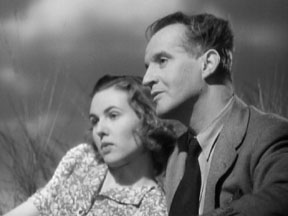
A DVD of the 1944 Powell and Pressburger film, A Canterbury Tale was released by Criterion a few days ago and a copy of it has already made its way to my door (thank you Amazon pre-order). The film takes its title from Chaucer’s Canterbury Tales and uses its theme of medieval pilgrimage to portray the wartime experiences of a group of Kentish citizens, a British soldier played by Dennis Price, an American soldier played by real life GI John Sweet, and a 'Land Girl' played by Sheila Sim. As the group arrives at the railway station in the fictitious small Kent town of Chillingbourne, the girl is attacked by the mysterious ‘glue man,’ who pours glue on the hair of girls seen with soldiers after dark. The three investigate the attack, thus beginning a pilgrimage that leads not only to the identity of the glue man, but also to a greater understanding of themselves.

For further information on this unusual film go to BFI ScreenOnline
Collection of Reviews and articles at the Powell and Pressburger Pages
Information about the film, transfer, and extra features at Criterion Collection
Article by Tamara Tracz at Senses of Cinema

Similar Powell and Pressburger films:
Edge of the World and I Know Where I’m Going!

Thursday, July 06, 2006

In Honor of Ingmar Bergman's Birthday on July 14, my Top Five Bergman films (in descending order):


Ingmar Bergman. Yes, I know you’re groaning, but when it comes to morose and redemptively weird you just can't beat him. His films have everything one needs: humor, death, love, beauty. You name it.

Summer Interlude Young love, a carefree summer holiday, alcoholism, a voyeuristic priest, an old woman who refuses to die, a poodle, accidental death, and lots of behind the scenes theatre stuff. You'll laugh (well, ok), you'll cry and you'll be thankful if your experience with first love didn’t end like this. A sad and beautiful film about love and loss.

The Seventh Seal What to say since most everyone's seen it. If you haven't, then I must ask how it is that you were able to resist a movie in which a soldier just returned from the Crusades rides around plague stricken Sweden putting off death by challenging him to a lengthy game of chess every evening while hanging out with new friends who are actors by trade and religious hysterics by nature? It's fabulous! Especially the part when the freaks come to town beating themselves and wailing because they feel the plague is God's punishment for their sins. Some things never change.

The Virgin Spring At first you think the whole thing's about this girl who's so pretty everyone makes an absurd fuss over her and you want to vomit, but then when she's killed almost immediately you get that there's a lot more to this flick (you also feel a little guilty for being so mean spirited). It’s medieval Sweden so her mother's a religious nut, of course, always mortifying her flesh to atone for her sins, but her dad's pretty mellow, so you have to wonder how the two of them ever hooked up. Once dad learns of his daughter’s death, it's off to the sauna where he prepares for a fight with her killers by beating himself with willow branches. He grabs the nearest knife and exciting he-man stuff ensues. Good overcomes evil very neatly in the end, but of course the girl’s still dead so it’s only so reassuring.

Wild Strawberries A universally appealing story about a man nearing the end of his life where he looks back at the joy and sorrow of the past and dwells too much on the mistakes (real and imagined) he's made in life. At the last it's bittersweet. (In terms of Swedish cinema that makes it practically an upper!) He manages to reconcile with his past and put it all into some sort of perspective. Some surreal dream sequences and a beautiful Erik Nordgren score make this an exceptionally lyrical film.

Ok. This last one's tough. Do I pick The Devil's Eye (about Don Juan, the Devil and a possible-time-off-for-good-behavior situation all done with a great heaping spoon full of black humor) or do I go for Through a Glass Darkly (about a schizophrenic chick living on an island with her husband, her father and her brother the last summer before they lock her up for good). She thinks God is a big black spider living in a crack in the wall of an unused room! The choice is frankly too difficult for me to make. On the one hand you have the Devil and the whole fiery pit of damnation thing and on the other you have insanity, family conflict, and Protestantism gone awry all in a picturesque island setting. I lean towards Through a Glass Darkly, but the power of Ultimate Evil is so strong. I guess it's a tie. Of course, if anyone has any definite feelings on this issue, be sure to let me know. It could decide me.

bergmanorama tribute site
bergman profile in senses of cinema
the bergman foundation

Sunday, June 18, 2006

Dear Old Dad: A Father's Day Tribute


For the first time in many a year my family did not get together for Father's Day today. While that was fine with me (dad gets a chance to relax at home in peace and quiet and I get some much needed work done) I have to admit that something is missing. While puttering around the homestead, I began to recall with fondness my father's charmingly grumpy ways. How he would complain each weekend while I was growing up that we had spent all his cash, the way he would become exasperated should one of us (most likely me) bring up any serious or shall we say unpleasant subjects right as he walked in the door. Didn't I know better than that? All dad wanted to do when he got home from work was to stand against the kitchen counter drinking a Johnny Walker on the rocks with a splash, not be hounded by the fools of women he was surrounded by. Lost in a dead end along memory lane, I became sentimental for times past and for the joy that an afternoon with dear old dad could bring. It occurs to me that plenty of families cannot get together for so important an occasion as Father's Day, so in case you are feeling as I do, I suggest that in honor of fathers everywhere, we have a double feature movie night.

As we all know, fathers have a special gift for exasperation. That look of persecution when the home front becomes too unmanageable, the tendency to retreat into the study or garage or wherever they hole up when they're trying to get away from it all, and, of course, the grin they give one when teased about these very things.

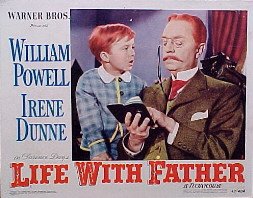
The first film must be Life with Father (1947). Starring William Powell and Irene Dunne with wonderful supporting roles played by Elizabeth Taylor and Zazu Pitts, the film shows how a strongwilled businessman and father loses control of his household when his wife and four sons take over. You'll feel right at home watching Powell carry on about household bills, house guests, and the role of the church, not to mention missionaries, young girls, and the purveyors of patent medicines.

Father of the Bride, please, not the Steve Martin remake, but the 1950 original with Spencer Tracy, Joan Bennett, and Elizabeth Taylor. Told in flashback voiceover by exasperated father supreme Spencer Tracy, the story is about the personal inconvenience to a father's household kingdom when his daughter decides to marry. The way he carries on, you'd think she did it just to spite him!

Sunday, June 04, 2006

New York in the Summertime


It’s been so damned hot here the last couple of days that I find myself thinking back longingly to the brief moment of June gloom we had just a couple of weeks ago. I feel cheated; I’m not ready for summer yet. I still need that last bit of cool weather before going into summer mole mode where I hide in darkened, air conditioned spaces and eat only cold foods, leaving the house only at night. I don’t know what to do with myself. When it’s this hot, most people go to a movie theatre and sit in the darkened caverns of full blast a/c with everyone else, but a quick glance at the newspaper has reminded me why I don’t go out to see movies more often. There’s just nothing out right now that I would willingly pay $9+parking to see and everything else that requires leaving the house just sounds too hot. My only trip outside today (a long walk) was a mistake. At 8 am it was already a million degrees and I arrived home melted, headachy, and crabby. So my answer to the 100+ degree heat is to barricade myself in the only room in the house equipped with air conditioning and watch movies, read, and dose with the cat. I suppose it would be comforting to watch movies with wintry themes requiring snow and frost, but seeing all those actors bundled up against the bitter cold makes me hot! I keep thinking, “What are they, crazy? Aren’t they hot?” I think the heat has begun to affect my brain since I can no longer tell the difference between real life and movies. I’ve decided to watch movies about people who look as hot and miserable as I feel or would feel if I were interested in braving the searing heat outdoors. So I have devised a sweaty summer movie night or several movie nights depending on your attention span and whether or not the weather breaks.

For whatever reason some of the best movies about being miserably hot in the summertime also happen to be set in New York in the fifties so I have chosen the following films:

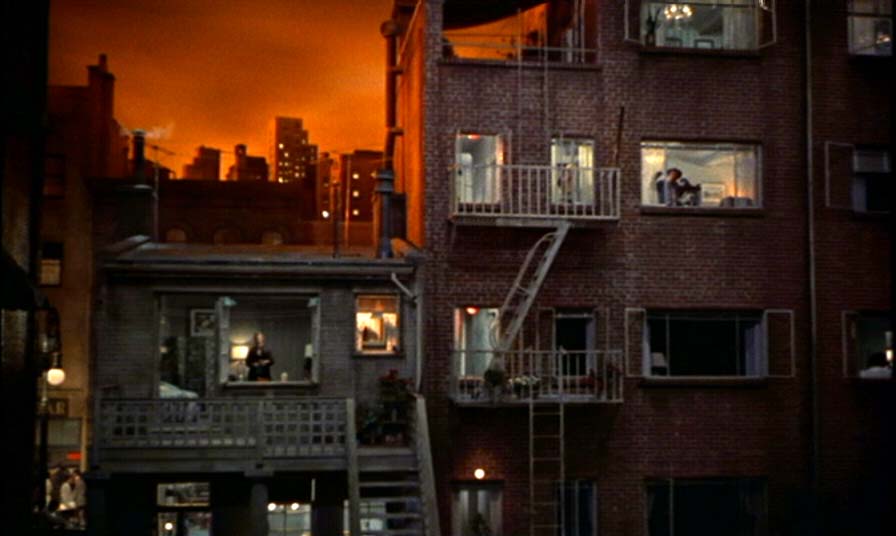
Rear Window (1954) Taking place entirely in a small New York apartment in summertime, Rear Window is about professional photographer L.B. "Jeff" Jeffries (James Stewart) who breaks his leg while getting an action shot at an auto race. With nothing else to do, Jeff wiles away the hours observing his neighbors, a lonely spinster, a ballet dancer and her beaux, a composer. When he notices that the nagging wife who lives across from him suddenly disappears, he begins to suspect that her gruff husband (Raymond Burr) may have murdered her. Jeff enlists the help of his high society girlfriend Lisa Fremont (Grace Kelly) and his nurse Stella (Thelma Ritter) to investigate.

My Sister Eileen (1955) Ruth (Betty Garrett) and her beautiful sister Eileen (Janet Leigh) come to New York's Greenwich Village from small town Ohio looking for "fame, fortune and a 'For Rent' sign on Barrow Street." From their stifling basement apartment they encounter artists, bohemians, and players of all kinds, but fame and fortune are nowhere to be found. Also starring Jack Lemmon, Bob Fosse, and Dick York.

The Seven Year Itch (1955) Publishing exec Richard Sherman (Tom Ewell) sends his wife and son to the country for the summer while he stays home, virtuously working in the New York heat. Though reveling in his temporary freedom, Richard has resolved not to carouse and philander like other men in his situation, but his already active imagination goes into overdrive when a beautiful blonde actress (Marilyn Monroe) moves in upstairs.

Bells Are Ringing (1960) Judy Holiday, Dean Martin, Jean Stapleton, Eddie Foy, Jr., Frank Gorshin, and every character actor you’ve ever seen in a 1950s movie. Ella Peterson is a switchboard operator at “Susanswerphone,” an answering service for busy New Yorkers. A good-natured busybody, Ella makes up for being painfully shy in her personal life by trying to improve the lives of the service’s subscribers. After a series of misadventures which bring her in contact with the police, the mob, and the purveyors of high culture, Ella finds love with a crooning playwright.

Sunday, May 21, 2006

Double Feature Movie Night: The Uninvited and The Ghost and Mrs. Muir

I woke up this morning to a general dampness outside that seems to be evidence of either light rain or over-enthusiastic dew. Early morning fog has given way to clouds and it’s chilly but decidedly muggy outside. At once I realized that Los Angeles’ celebrated June gloom seems to have arrived early this year. Weather like this makes me (and everyone else in my family) want to go ‘up the coast.’ I long to linger on deserted stretches of shoreline, buffeted by strong winds and listening to the sounds of seabirds crying in the distance or to stand atop a craggy cliff, again buffeted by strong winds, the sea roaring below. While sitting on my soggy back step, my mind absorbed in a world of clichés drawn from Gothic literature and Hollywood movies, I realized my trip up to the land of ‘Bronte beaches’ (my sister’s phrase) was not to be. Alas, poverty and the exorbitant price of gas forbid my making this journey at the present moment. So I asked myself, “What is one to do when a trip up the coast is indicated but simply cannot be undertaken?” Why, watch a movie, of course. So I have devised a Bronte Beach Movie Night that should, if not exactly cure my wanderlust, at least allay it somewhat.

After but only a moment of thought, two films came to mind: The Uninvited and The Ghost and Mrs. Muir. Though set in England rather than in California, these films are set in the proper coastal settings, with all the necessary moodiness and melancholy. The Uninvited begins with a brother and sister who discover an abandoned seaside house while on vacation. Buying the house for a remarkably low price, they begin to hear sounds of a woman crying during the night, much mystery and mayhem follows. The screenplay, written by Dodie Smith (101 Dalmations, I Capture the Castle) contains some wonderfully understated and sarcastic humor, and the characters are delightfully familiar, country doctors, devoted family retainers, and one Mrs. Holloway who is strongly reminiscent of Mrs. Danvers in Rebecca. Is it coincidental that she shares her name with a British women’s prison?

The Ghost and Mrs. Muir contains a similar beginning, a young widow looks for a house in a seaside village and decides to rent (against her estate agent’s advice) a remote “cottage” overlooking the sea only to find that it’s haunted. Far from becoming a mystery, however, the story becomes a meditation on love and loss. Directed by Joseph L. Mankiewicz (All About Eve, A Letter to Three Wives) with a score by Bernard Herrmann (Citizen Kane, Vertigo), this film has all the melancholy beach shots and windswept vistas one could wish for.

Thursday, May 18, 2006

LACMA: Written for the Screen

Los Angeles County Museum of Art is celebrating the best of film writing by showing ten films listed in the Writers Guild of America’s 101 Greatest Screenplays list. Shown in double features on Friday and Saturday nights, the films are grouped thematically, Casablanca and Manhattan, The Lady Eve and Groundhog Day, Rear Window and High Noon, Sunset Blvd and Adaptation, with an opportunity to attend a discussion of the art of writing for film by five of the screenwriters on the list. Perhaps the most interesting pairing is that of Rear Window and High Noon, shown under the heading of Unity of Place and Time on Friday May 26. These films have been linked together because of their atmosphere of claustrophobia and suspense, Rear Window through its use of limited space and High Noon through its restricted use of time.

Written for the Screen will run from May 19 to June 3, Fridays and Saturdays, with programs starting at 7:30 pm in LACMA’s Leo S. Bing Theatre. Tickets can be purchased in advance at the museum ticket office or online. Purchase of a film ticket includes entrance to the galleries (except specially ticketed exhibitions). General Admission is $9, members and students $6, tickets for the second film only $5 (cannot be purchased in advance).