Monday, April 24, 2006

THIS JUST OUT The Films of Faith


While I understand that everything in the world's largest theocracy, the United States of Jesusland, needs to be marketed to Christians, I do think that Warner Bros may be stretching it a bit here. For one thing, Protestantism is the name of the game these days and their Films of Faith Collection focuses wholly on Catholic themes. Perhaps they made this decision based on the TV ratings from the Pope’s funeral last year, one never knows. While I love a theme and admire the (probably unintended) kitschy ambition of the collection, their selection of films simply doesn't gratify me. That being the case, I have created my own collection of Catholic screen gems, focusing on nuns.

Song of Bernadette (1943) Jennifer Jones as the young girl who sees the Virgin Mary, Vincent Price as a cynical politician, and Gladys Cooper as a mean, jealous Mother Superior.

Bells of St Mary’s (1945) Bing Crosby is a singing priest with unconventional ways.

Black Narcissus (1947) Deborah Kerr, Jean Crain, Kathleen Byron, and Sabu – mad nuns, enough said.

Heaven Knows Mr Allison (1957) Deborah Kerr is a nun stranded on an island in the south Pacific with Robert Mitchum during WW2.
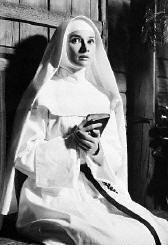
The Nun’s Story (1959) Audrey Hepburn plays a nun whose faith and vows are forever being tested. Will she be able to conform to the ways of the church or will she leave the order?

Lilies of the Field (1963) Sydney Poitier plays an unemployed construction worker who happens upon a group of German nuns in the Arizona desert. The best part is when he teaches them Southern spirituals.

The Sound of Music (1965) Julie Andrews, Christopher Plummer, Anna Lee, and Richard Haydn - A postulant falls in love and leaves the order. To music.

The Trouble with Angels (1966) Where Angels Go...Trouble Follows (1968) Rosalind Russell, Mary Wickes, Hayley Mills, Susan Saint James, and others. The first one is the best. Nuns and their charges navigate the complexities of Vatican II and the swinging sixties.

The Singing Nun (1966) Sister Ann’s singing gets her a record deal and everyone is listening to her light-hearted songs, but is she prepared for her new found fame?

The Flying Nun (TV 1967-70) Sally Fields – the misadventures of a nun whose enormous wimple enables her to fly.

A couple of films that feature nuns rather less prominently than the others, but are worth the price of admission:

Applause (1929) This vehicle for Ziegfeld piano sitter Helen Morgan tells the story of Kitty Darling, a faded burlesque star who sends her daughter to a convent to prevent her from following in her footsteps. Beautiful scenes of pre-Vatican II nuns walking with their trailing medieval habits amidst statuary and white swans.

Portrait of Jennie (1948) Jennifer Jones again, this time with Joseph Cotten. Lilian Gish plays the aging nun who remembers the mysterious Jennie from years before when she was sent to a convent after her trapeze artist parents died in a freak accident.

Nuns in Hollywood
Nun's Habits
Nun Dolls
Official Vatican Website

Monday, April 17, 2006

TO DO IN LOS ANGELES The Brothers Quay at USC and AMPAS


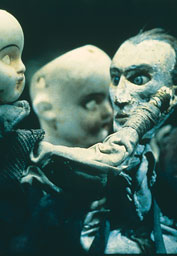
Famous stop-motion experimental animators Steven and Timothy Quay will be making their first public appearances in the United States this week. The first being at the Academy of Motion Picture Arts and Sciences on Friday evening and then on Sunday afternoon at USC's School of Cinema-Television. Both events will include a presentation of their work, discussion of their films and influences, and a Q & A period.

The Quays have been making animated films since the 1970s and are well known for their innovative and unique style, which is by turns bizarre and dreamlike. Influenced by the Czech artist Jan Svankmajer, their classic 1986 Street of Crocodiles is considered one of the best animated films of all time and has influenced countless filmmakers.

If you can't make it, but you are interested in seeing their films The Brothers Quay Collection provides a good introduction.

At AMPAS - Friday April 21 at 7:30pm at the Academy of Motion Picture Arts and Sciences' Samuel Goldwyn Theatre located at 8949 Wilshire Boulevard in Beverly Hills. (310) 247-3600. Tickets are $5 for the general public and $3 for Academy members and students. Tickets for this event will be available on the night of the screening, if still available. On the day of the event, doors open at 6:30 p.m. Tickets can be purchased at the time of the event, but they have been selling tickets by mail so how many seats are left is hard to say.

At USC - Sunday April 23 from 10 to 12 noon at USC School of Cinema-Television's Eileen Norris Cinema Theatre located just beyond the Booth Ferris Memorial Hall on West 34th Street in Los Angeles. This event is free.

Saturday, April 15, 2006

Jayne Mansfield Made a Career of Being a Girl


April 19 is Jayne Mansfield's birthday and though perhaps not a great actor or comedienne, she was a great star and became one of the leading icons of the late 1950s. In case you’ve never experienced Jayne Mansfield before, now might be the time. The films she made are light and funny and exhibit a classic 1950s obsession with good, clean sex. Probably her best film (and my favorite) is the 1956 Will Success Spoil Rock Hunter? A spoof of the TV advertising industry, Rockwell Hunter has found the perfect spokesmodel for Stay-Put lipstick, his big account. When Rita Marlowe, the famous actress with the oh-so-kissable lips, comes to New York he knows it’s his big chance, but in order to secure the account, Rock has to pretend to be Rita's "Lover Doll." Is Rock cut out to be a high power executive after all? Co-starring are Tony Randall, Betsy Drake and Joan Blondell in her standard 1950s sidekick role.

I would think that Turner Classic Movies would, with their usual perspicacity, show a few of her movies on her birthday, but a quick glance of their online schedule proves me a hapless optimist. So while TCM can't help us on this one, several of her films are on DVD and Amazon has virtually everything she ever made. Netflix has a few, but they seem to be specializing in the exploitation films she made in Europe in the early 1960s, which are pretty painful. Even those might be worth watching as long as you’re not expecting too much. They do have the 1964 double feature Primitive Love/Mondo Balordo, which pairs Jayne with the horror great Boris Karloff. Apparently, Jayne plays some part in an international freak show which includes transvestites, 27-inch tall singing men, and Japanese bondage. You never know, it might be worth checking out.

Some of her better movies you might want to look for are: The Girl Can’t Help It with Tom Ewell, The Burglar, a low budget noir based on a David Goodis novel, and Kiss Them For Me with Cary Grant.

"A forty-one inch bust and a lot of perseverance will get you more than a cup of coffee-a lot more. But most girls don't know what to do with what they've got."

Official Jayne Mansfield Website

Thursday, April 13, 2006

TO DO IN LOS ANGELES Ziggy Stardust and the Spiders from Mars


"I have never seen anyone turn on an audience, men as well as women, the way he did that night. The minute he strode on stage, I could see that he was a character looking for a film."

As part of their 5th Annual Music Documentary Series, AFI at the ArcLight is showing D.A. Pennebaker's 1973 documentary Ziggy Stardust and the Spiders from Mars. Not released until 1983, Pennebaker's film captures David Bowie's final performance as alter-ego Ziggy Stardust in 1973 at London's Hammersmith Odeon Theater and features songs from Ziggy Stardust, Hunky Dory, Aladdin Sane, and other Bowie albums, as well as backstage footage.

Ziggy Stardust will be shown on Wednesday April 19 at 8 pm at ArcLight Hollywood, 6360 W. Sunset Blvd, Los Angeles, CA.

Tickets are $11, $10 for ArcLight, AFI and Skirball members, on-site parking is $2 for four hours with validation.

For more information about the series go to AFI at the ArcLight
Information about Ziggy Stardust at the Ziggy Stardust Companion

TO DO IN LOS ANGELES 8th Annual Film Noir Festival at American Cinematheque


It's time for the Film Noir Festival at American Cinematheque again. If you're looking for something to do this weekend, the festival will be showing double features at both the Egyptian in Hollywood and the Aero in Santa Monica. This weekend's schedule features films by Jean Negulesco, Robert Wise, Sam Fuller, and Jacques Tourneur. Noir fans, take note. Many of the films shown at the festival are not on DVD so this is often the only opportunity to see them. Festival host Eddie Muller often provides interesting background information about the films as well as interviews with actors and directors involved so it's always a unique experience.

The Film Noir Festival runs through April 16th at American Cinematheque, a non-profit organization dedicated to showing the best of film, classic to avant garde.

The Egyptian Theatre is located at 6712 Hollywood Boulevard in Hollywood
The Aero Theatre is located at 1328 Montana Avenue at 14th Street in Santa Monica
Tickets are usually $9, $6 for members, and $7 for seniors/students with valid ID.

Thursday, April 06, 2006

"It's Sister Ruth. She's Gone Mad"

I have decided that, for me, the Ultimate Movie operates along the same lines as the Ultimate Ballet. The Ultimate Ballet should, of course, have the following components: an exotic locale, unrequited love, madness or a curse or something, and a healthy dose of hardcore angst. The Ultimate Movie I have in mind has a bonus, however. Nuns. For me, there are few things as picturesque as a pre-Vatican II nun and since they exist outside my personal experience I find them exotic as well.

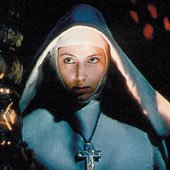
Made in 1947 by Michael Powell and Emeric Pressburger, Black Narcissus is about a group of Anglican nuns who travel to a remote village in the Himalayas to start a new branch of their order. A local Prince gives the nuns a huge but dilapidated palace set high upon a cliff and though they are warned that the House of Ladies (it used to house a local Prince’s wives) is no place for a nunnery, they forge ahead with their plans to do good, educating the young girls and curing disease. Beset with problems from the get-go, the young Sister Superior (Deborah Kerr) tries to maintain control, but the new environment seems to encourage nostalgia and exaggerated emotional outbursts and she is forced to turn to Mr. Dean, the Prince's agent, for help.

As confusion increases and tensions rise, the nuns find themselves at sixes and sevens. Sister Superior becomes lost in the long ago, dreaming of Conrad, the young man who jilted her, throwing her into the arms of the church; Sister Phillipa plants flowers instead of much needed vegetables while staring into the distance; and the paranoid and sinister Sister Ruth (Kathleen Byron) becomes obsessed with Mr. Dean and leaves the nunnery, wearing lipstick! The plot thickens and violence ensues. I won't give it away, but the end is very much like a tragic ballet, full of over the top melodrama. I’ve said it before and I’ll say it again: with mad nuns, you couldn’t possibly go wrong.

Truly, it is an incredibly beautiful film and I think the story would make the most amazing ballet. It has all of the aforementioned necessary qualities plus a mad nun. It could be like Giselle, only they’re nuns in the Himalayas not Rhineland maidens and Ruth dies more violently than Giselle does, but they both have a mad scene and I think we need another ballet with a mad scene. It’s time.

Friday, March 24, 2006

TO DO IN LOS ANGELES 2006 Silverlake Film Festival

Taking place this week (March 23-31) the Silverlake Film Festival will be presenting over 200 films, 85 of which are premieres. A selection of independent film and video, the festival showcases films that might otherwise not be seen, especially on the big screen. Series within this year's festival will focus on third world cinema, new medias, films promoting social change, and a tribute to notorious Hollywood legend, Fatty Arbuckle. The films will be shown at LACE, the ArcLight, the Vista, and several other venues on the Eastside, making this a communitywide event and special programs and panels will include local and nationally recognized filmmakers, actors, activists, and politicans.

Information on times, locations and special events at the website of the 2006 Silverlake Film Festival

Monday, March 13, 2006

The Season of the Biblical Epic


Several Easters ago, there was a Jesus-Christo-a-thon on TV wherein they showed only biblical epics for 24 hours. Of course, I was there...proving to all that I had no life, but in my constant search for meaning-through-kitsch it was essential that I experience this cultural moment. Of course, among many other things, I and my partner in societal scrutiny noticed a trend in the casting of Pontius Pilate in the New Testament films. Whether it was in the older Biblical Epics (we'll call them B.E.s for short) or even the more recent examples, there seems always to be a bizarre tendency to portray P. Pilate as a femmy Brit! In the 1961 Nicholas Ray classic King of Kings, P. Pilate is played by the fey Hurd Hatfield (of Dorian Grey fame), in Scorsese’s Last Temptation of Christ he is played by David Bowie, even in Monty Python's Life of Brian, Michael Palin camps him up as being just a bit of a nancy. He has a lisp and everything. In all, I noted only one example where this was not the case. In The Greatest Story Ever Told, starring Max Von Sydow in a stylish array of robes in Calvin Klein hues, Pilate is played by Telly Savalas, which as you can imagine is completely unbelievable as he is altogether too butch for the role. I didn't believe him for a minute.

This Easter we are planning to do the whole thing again, an activity I highly recommend to you. We shall dye Easter eggs, eat See’s Chocolate Bunnies, and take in the cheesy glory that is the B.E. You can test out our theory and watch the films of the New Testament or if you’re really keen, enjoy a Passover/Easter Combo. Kick off the weekend with the C.B. De Mille Old Testament extravaganza, The Ten Commandments starring Charlton Heston as Moses and Yul Brynner as Ramses, with Anne Baxter, Edward G. Robinson, Vincent Price, Yvonne de Carlo, Debra Paget, and many, many others. Follow up with a Victor Mature film or two, Samson and Delilah or The Robe, and experience the paramount achievements of early 1960s cinema with King of Kings and The Greatest Story Ever Told. The experience will change your life and improve you as a person, I guarantee it.

Saturday, March 04, 2006

FILM REVIEW: I am Cuba

“Why are you running away? You came to have fun. Don’t avert your eyes. Look! I am Cuba. For you, I am the casino, the bar, hotels and brothels. But the hands of these children and old people are also me."

I Am Cuba was made in 1964 as a propaganda film by the Soviet government. Coauthored by Soviet poet Yevgeny Yevtushenko and Cuban novelist Enrique Pineda Barnet and directed by Russian filmmaker Mikhail Kalatozov, I am Cuba explores European and American influences on Cuba during the pre-revolutionary period and chronicles the events leading up to the revolution itself. The first segment looks at Cuba under Batista and portrays it as a playground for Americans whose presence encourages the exploitation of women. The second segment tells the story of an elderly man living in poverty because the land on which he grows his sugar cane is sold to the United Fruit Company, an American agricultural corporation and the third segment follows a group of university students who plot against the Batista regime, but are caught and become martyrs to the revolution. In the final segment, a peasant joins the revolution after being driven from his home by Batista’s bombs. He goes to a rebel camp in the Sierra Maestra and joins Castro's troops to fight for the revolution.

The film begins with aerial shots of the Cuban landscape. Starting at the coast, the camera moves inland and a woman’s voice recounts the history of the Spanish conquest of Cuba beginning with Christopher Columbus’ visit to the island. Cuba is depicted as a country of great natural beauty that is colonized for the wealth that it can bring to the Spanish colonizers. After this brief introduction the film cuts to pre-revolutionary Cuba under Batista and looks at the long term consequences of colonial influence on Cuban culture.

In one of the most arresting scenes in the film, Kalatozov presents one of the main themes of the film: American domination through intimidation and the corrupting influence of American culture. The scene begins with the interior of a lavish nightclub decorated in a jumble of early 1960s Tropical style, Easter Island heads, and Africana. The camera examines a group of beautiful women who sit at the bar listening to a singer reminiscent of Otis Redding perform a nonsensical love song. As the camera moves away from the women, a group of American men sit discussing which of the women they want, claiming them proprietarily. A young woman, Maria, enters the nightclub and is taken to one of the men. She dances with him and, in a metaphor for American aggression, is dragged around the floor, repeatedly pushed into the arms of the other men. As the music becomes more rhythmic she moves involuntarily and the camera mimics her confusion by moving wildly among the sticks of cane that hang from the ceiling. In the background, women are shown dancing in bikinis and pseudo-African masks, showing how they are objectified and exotified for the American tourists.

This scene can be seen as an extended metaphor for American political, economic, and social relations with Cuba during Batista’s control. The American men in the nightclub feel they own Cuba and its people. The men feel a sense of ownership over Maria and treat her as a plaything, brutally, as if she has no say in her treatment or fate. She and the other women are seen as quaint and exotic and seem to be designed for the American’s pleasure and use. The visual aspects of this scene reinforce this idea. The nightclub’s background which provides a generalized sense of the tropical and exotic reveals that the Americans do not really know where they are or what culture it is they are visiting. For them, Havana is simply a vacation spot where their actions have no consequences and they may do as they please. The American soul music sung in Spanish increases this sense of confusion for the men, blurring the line which separates the United States from Cuba.

When one of the American men goes home with Maria, he wakes up to a different Havana from the one that existed for him the night before. He leaves the shanty Maria lives in only to get lost among the ramshackle buildings where small children beg him for money. He begins to panic and run from the crowd that has gathered around him. The woman’s voice from the opening of the film returns and asks him, “Why are you running away? You came to have fun. Don’t avert your eyes. Look! I am Cuba. For you, I am the casino, the bar, hotels and brothels. But the hands of these children and old people are also me." The rich American becomes lost in the Cuba that exists to support his playground; the world of pleasure that the rich Americans come to Havana to enjoy falls away and all that remains is the poverty of the people who must sell themselves to foreigners in order to survive.

Though I am Cuba was created as agitprop for the Soviet government, the film’s critical insight and incredible cinematography work together to create a film of great power. A must see for fans of international film.

Read a review of I am Cuba by Gary Morris at Bright Lights Film Journal

Friday, February 10, 2006

TO DO IN LOS ANGELES Dreams Fulfilled: African American Arts in Los Angeles

From February through the end of April, The Huntington Library in San Marino, that's just south of Pasadena's Old Town in case you didn't know, is having a series of lectures, music, dance, and film celebrating African American arts and culture. The first of these events, on February 16 from 5:30 to 7pm, is a lecture focusing on African American artists in Los Angeles, from poet Langston Hughes, to Joseph Rickard, founder of the First Negro Classic Ballet in South Los Angeles in 1947. Other events include performances of the music of Harold Bruce Forsythe and The Langston Hughes Project, a reading of Hughes' poetry to jazz. The Library will also be displaying materials from their collection, including the papers of Hughes, Forsythe, and Rickard.

The Huntington Library is located at 1151 Oxford Road San Marino 626-405-2146 Regular admission in $15 for adults, $10 for students with ID, and $6 for kids, admission for the events ranges from $15 to free and seating is first come first serve.

Information on the Harlem Renaissance

Books by Langston Hughes and other writers of the Harlem Renaissance

Sunday, February 05, 2006

"Miss Page is unable to dance tonight...or, indeed, any other night."


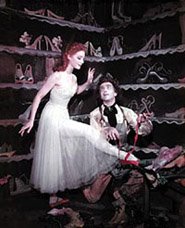
Moira Shearer died on Tuesday at the age of 80 in Oxford, England. Cast as Vicky Page in Powell and Pressburger's 1948 film The Red Shoes, Moira Shearer was my first exposure to ballet, the first ballet dancer I ever saw. I was so young the first time I saw The Red Shoes that years later all I could remember of it was the row of red pointe shoes and the cane that rapped the floor smartly when it had found the perfect pair.

While Moira Shearer danced with the Sadler's Wells Theatre Ballet, now the Royal Ballet, in some of the most important roles in British ballet, made several other films, acted, wrote, and lectured, it is for her performance in The Red Shoes that she will be remembered.

See Moira Shearer in two other Michael Powell films:
The Tales of Hoffman and Peeping Tom